
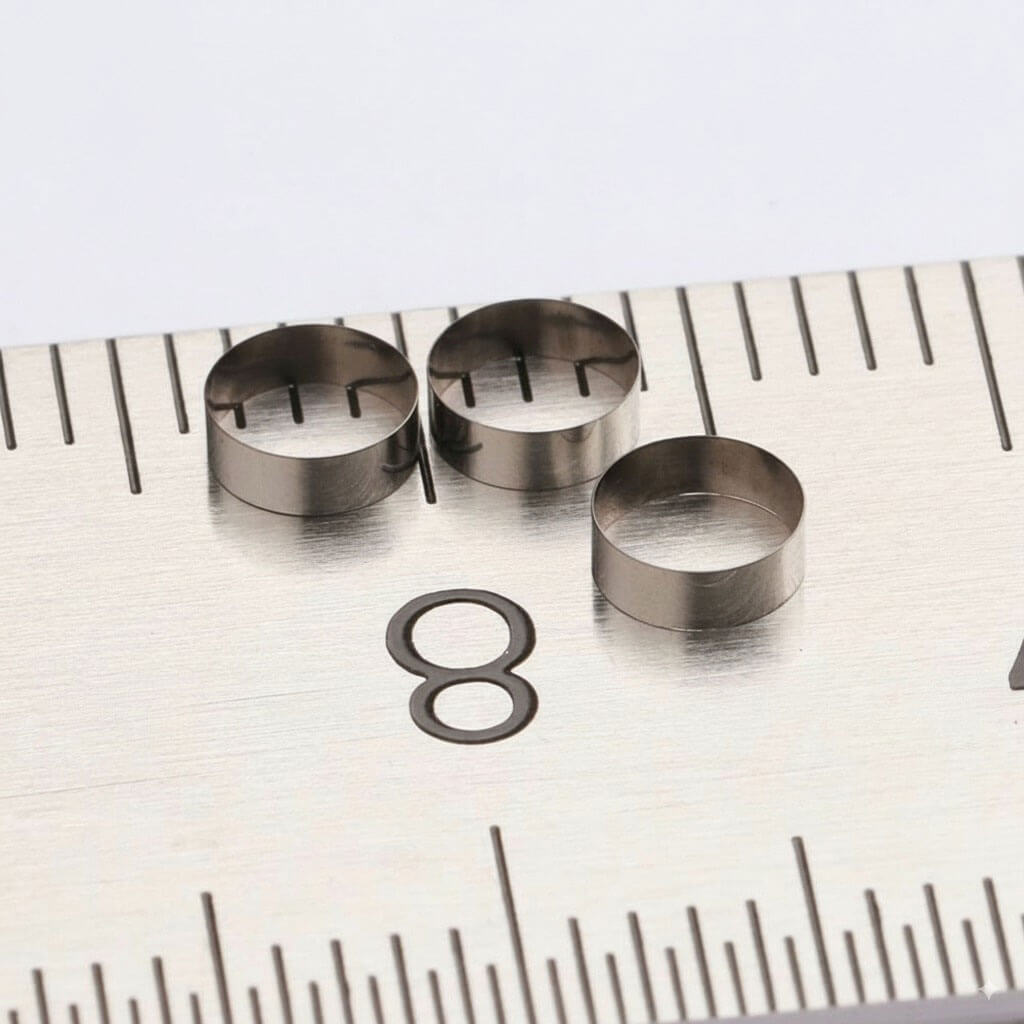

Currently, most Medical marker bands on the market are made of precious metals such as Platinum-iridium (Pt90/Ir10), platinum (Pt), gold (Au), and their alloys. However, with the continuous advancement of medical technology and the growing demand driven by global population aging, the market for medical tantalum (Ta) materials is also experiencing sustained growth.

Medical tantalum marker bands further enhance properties such as biocompatibility and corrosion resistance. Manufactured through ultra-precision processing, the material quality and intricate fabrication techniques enable these bands to produce clear, accurate images under X-ray and other imaging equipment, providing reliable guidance for device positioning during interventional procedures.
Applications and Performance of Tantalum Marker Bands
As a biomedical material intended for human implantation, tantalum must meet stringent standards and classification requirements to ensure patient safety and health.
A. In Vascular Interventional Procedures
For applications such as cardiac stent implantation and neurointerventional therapy, tantalum marker strips are attached to medical devices like catheters, guidewires, or stents. They enable physicians to clearly observe the position and trajectory of these devices within the body under X-ray fluoroscopy. This facilitates precise surgical guidance, ensuring accurate delivery of the device to the target lesion while minimizing surgical risks and complications.
In certain interventional procedures involving stents—such as those treating biliary tract, portal vein, trachea, main bronchus, esophagus, intestinal tract, and various organic stenoses—self-expanding stents woven from nickel-titanium alloy wires are commonly used. To facilitate intraoperative visualization of the stent’s position, radiopaque markers are typically placed at both ends and the center of the stent. Tantalum rings are one of the commonly used radiopaque markers.
B. Applications in Tumor Therapy
Tantalum marker bands can be employed in interventional treatments for various tumor types and locations, including ovarian cancer, esophageal cancer, and liver cancer. During interventional procedures, the tantalum marker band is delivered to the target site using fluoroscopic guidance. Imaging techniques like X-ray or CT are used to locate and visualize its position and dimensions. Since tantalum marker bands can be integrated with precision medical approaches like targeted therapy and immunotherapy, they accurately delineate tumor location and boundaries. This provides more precise guidance for targeted drug delivery and radiotherapy, enhancing treatment efficacy while minimizing damage to healthy tissues.
C. In Microcatheter Clinical Applications
The distal tip of microcatheters features a radiopaque segment—the microcatheter’s radiopaque marker. Given microcatheter structural characteristics, tantalum marker strips require millimeter or micrometer-level dimensions and micrometer-level thickness, alongside excellent surface finish and malleability.
D. In Medical Imaging Equipment
During interventional procedures guided by CT, MRI, and similar technologies, clearer and more accurate contrast materials are essential for precise localization. Tantalum marker strips are favored for their superior imaging performance, further driving market demand.

Advantages of Tantalum Marker Bands
The application advantages of tantalum marking tape in the medical field extend beyond its outstanding imaging performance, excellent biocompatibility, superior corrosion resistance, and favorable processing properties. It also demonstrates exceptional compatibility with other materials.
Tantalum marking tape integrates well and is compatible with various common medical device materials, such as metals and polymers. In composite medical devices, tantalum marking strips synergize with other materials to leverage their respective strengths, enhancing the overall performance of the device. For instance, in tantalum-coated orthopedic implants, the marking strip bonds tightly with the implant’s base material, improving both biocompatibility and osseointegration while delivering excellent radiographic visibility.
Specifications of Tantalum Marker Bands
Tantalum’s excellent machinability allows it to be fabricated into marking bands of various shapes and dimensions to meet diverse medical device design and application requirements. For instance, tantalum marking bands can be produced as ring structures with different inner diameters, outer diameters, and thicknesses, or processed into bands with specialized shapes or notches as needed for optimal integration and fixation with medical devices.
Contrast Marker Application Center
Note: For additional sizes, please refer to the table below.
The following table provides the dimensions of the tantalum Marker bands: more…Inquiry directly!
| Material | Inner Diameter (ID) | Outer Diameter (OD) | Length |
|---|---|---|---|
| Ta | 0.0051″ | 0.0098″ | 0.04″ |
| Ta | 0.0059″ | 0.0177″ | 0.04″ |
| Ta | 0.0071″ | 0.0118″ | 0.04″ |
| Ta | 0.0079″ | 0.013″ | 0.04″ |
| Ta | 0.0082″ | 0.0142″ | 0.0394″ |
| Ta | 0.011″ | 0.015″ | 0.0197″ |
| Ta | 0.0118″ | 0.0177″ | 0.04″ |
| Ta | 0.0118″ | 0.0236″ | 0.0472″ |
| Ta | 0.0118″ | 0.0276″ | 0.3937″ |
| Ta | 0.0122″ | 0.0197″ | 0.04″ |
| Ta | 0.0394″ | 0.0414″ | 0.04″ |
| Ta | 0.0457″ | 0.0473″ | 0.04″ |
| Ta | 0.195″ | 0.199″ | 0.08″ |
| Ta | 0.219″ | 0.223″ | 0.0394″ |
| Ta | 0.295″ | 0.301″ | 0.04″ |
| Ta | 0.2953″ | 0.3008″ | 0.0787″ |
| Ta | 0.343″ | 0.349″ | 0.06″ |
| Ta | 0.363″ | 0.371″ | 0.04″ |
| Ta | 0.3661″ | 0.3732″ | 0.06″ |
| Ta | 0.367″ | 0.3741″ | 0.06″ |
| Ta | 0.367″ | 0.375″ | 0.04″ |
| Ta | 0.369″ | 0.3761″ | 0.06″ |
| Ta | 0.369″ | 0.377″ | 0.04″ |
| Ta | 0.374″ | 0.3803″ | 0.0787″ |
| Ta | 0.374″ | 0.382″ | 0.04″ |
| Ta | 0.3819″ | 0.3882″ | 0.05″ |
| Ta | 0.382″ | 0.39″ | 0.04″ |
| Ta | 0.416″ | 0.424″ | 0.04″ |
Conclusion
The current market for orthopedic implant medical devices is substantial and exhibits steady growth. Tantalum marking strips can be applied in the R&D and production of orthopedic implants. Furthermore, the continuous emergence of novel orthopedic implant materials and technologies, such as intelligent bone regeneration techniques, provides broader application prospects for tantalum marking strips in the orthopedic field.
Amidst an aging population and rising incidence rates of cardiovascular diseases, tumors, and other conditions, the number of patients requiring interventional procedures and related surgeries is increasing, thereby driving demand for medical consumables like tantalum marking bands. As medical technology advances, requirements for the size and shape of marking bands will become increasingly diverse and personalized. In the future, it will be possible to customize miniaturized, personalized tantalum marker bands based on specific treatment sites and patient conditions, thereby reducing physical trauma and discomfort for patients.