
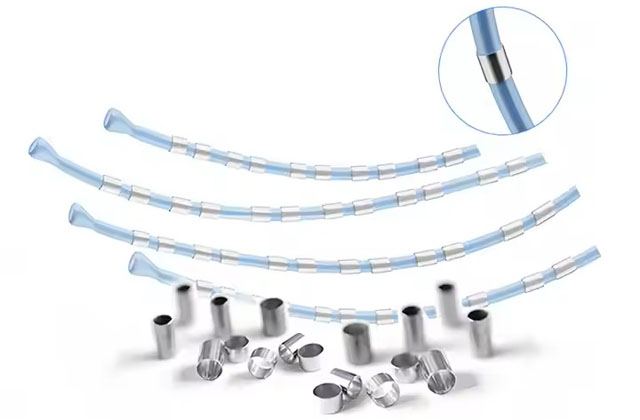
Radiopaque Marker Bands for Catheter Positioning in Vascular Procedures
In the realm of modern medicine, the ability to accurately position medical devices within the human body is crucial for successful diagnostic and therapeutic outcomes. Radiopaque marker bands have emerged as indispensable tools in achieving this level of precision, particularly in vascular procedures. These small yet essential components are designed to enhance the visibility and localization of catheters during complex interventions, ensuring optimal placement and reducing the risk of complications.
The Role of Radiopaque Marker Bands in Catheter Navigation
Radiopaque marker bands are typically small cylindrical or tubular structures made from materials such as platinum or gold, chosen for their high radiopacity and biocompatibility. When incorporated into catheters, these bands serve as reference points, allowing healthcare professionals to visualize the device’s position and orientation inside the body under imaging technologies like X-ray, fluoroscopy, or CT scanners. This is particularly important in vascular procedures, where navigating intricate and tortuous vascular paths is often required.
For instance, in cardiovascular and neurovascular procedures, catheters with marker bands ensure accurate positioning, improving treatment success rates for conditions like blockages and aneurysms. By visualizing these markers under fluoroscopy, healthcare providers can precisely direct catheters to target locations, such as arterial branches or aneurysms. This enhanced precision not only reduces the risk of errors but also minimizes the need for extended fluoroscopy exposure, thereby limiting radiation exposure for both patients and healthcare providers.
Design Considerations and Material Selection
The design of radiopaque marker bands involves careful consideration of size, shape, and material composition. The dimensions of marker bands must be carefully designed to ensure they are visible on medical images while not impeding the functionality of the catheter. Custom radiopacity can be achieved by adjusting the thickness and composition of the radiopaque material, allowing for precise control over visibility in different imaging modalities and tissue types.
Common materials used in marker bands include platinum, gold, platinum-iridium, tantalum, and tungsten. Each material offers unique advantages in terms of radiopacity, biocompatibility, and durability. For example, platinum is highly radiopaque and biocompatible, making it ideal for long-term implants. Platinum-iridium, a superior choice for imaging clarity and corrosion resistance, is often used in high-stress devices. Gold offers a balance of radiopacity and biocompatibility at a competitive cost.
Applications in Vascular Procedures
The applications of radiopaque marker bands in vascular procedures are extensive and varied. In cardiology, angioplasty markers are vital for the precise deployment of stents within coronary arteries. In neurology and urology, catheter markers help navigate catheters to exact locations, minimizing potential complications and improving procedural outcomes. Additionally, marker bands play a crucial role in embolization procedures, assisting in tracking the embolic material’s distribution within the target vessel and confirming its occlusion.
In endovascular aneurysm repair (EVAR) and coil embolization for cerebral aneurysms, these tools are used to accurately position stent-grafts or coils within the aneurysm sac. Radiopaque markers can also help create precise vascular maps by marking critical reference points, bifurcations, or lesions, aiding in surgical planning and reducing the risk of complications during procedures.
Conclusion
Radiopaque marker bands have revolutionized the field of vascular procedures, allowing healthcare providers to perform intricate interventions with unparalleled accuracy and safety. Their versatility and applications in catheter navigation, stent placement, embolization, aneurysm treatment, and vascular mapping make them indispensable tools for modern vascular specialists. As technology continues to advance, we can expect even more sophisticated radiopaque markers to further improve the precision and outcomes of vascular procedures, ultimately benefiting patients worldwide.