
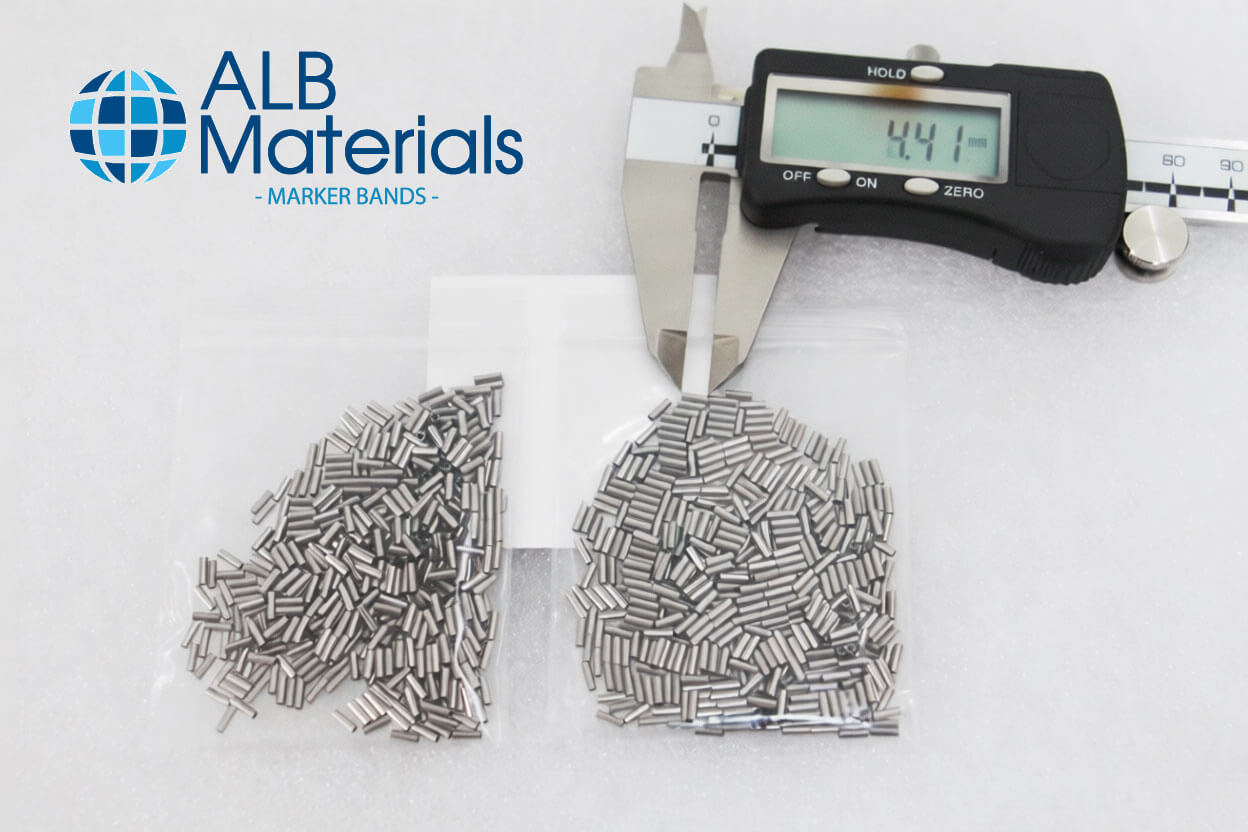

A 6F guiding catheter has an inner lumen of about 1.8 mm. The physician steering it through a calcified iliac artery never sees the tip. What the fluoroscopy screen shows is a small bright ring just behind the distal end of the shaft, and every decision that follows (where the balloon opens, where the stent lands, how far the wire has travelled) is read from that ring.
That is a heavy job for a section of drawn tubing that may measure 0.25 mm in length.
What a marker band is
A marker band is a short length of radiopaque tubing pressed, swaged or bonded onto a catheter shaft, guidewire, stent delivery system or balloon. The metal has a high atomic number, so it absorbs X-rays far better than soft tissue does and reads as a dense, sharply defined ring on fluoroscopy while everything around it stays grey.
Sizes run smaller than most people expect. The range ALB Materials Inc stocks:
- outside diameter from 0.25 mm to 12 mm
- wall thickness from 0.015 mm to 0.5 mm
- lengths cut to 0.25 mm with a burr-free edge
- OD, ID and wall held to roughly ±0.01 mm on a typical drawing
The hard part is not the metal. It is cutting a 0.02 mm wall without rolling a burr onto the edge, because a burr that survives inspection will scratch a vessel wall or jam inside an introducer.
Four decades, one idea
When balloon angioplasty took hold in the early 1980s, operators needed to know where the balloon sat inside a coronary artery. The first answer was a plain platinum ring crimped onto the shaft. Crude, but it worked, and the idea has not changed much since.
What changed is everything around it. Guide catheters went from 8F to 5F. Balloons shrank. Neurovascular work pushed shafts below 1 mm in outer diameter, and the bands on them below 0.5 mm. A part that was once a visible ring on a drawing is now a detail you need magnification to inspect.
What the band does during a case
Positioning comes first. On a balloon catheter, one or two bands define the working length, so the operator knows where inflation starts and stops before any contrast goes in. On a stent delivery system, a proximal and a distal band bracket the stent. If the distal band sits past the lesion, the stent lands past the lesion, and the band is the only thing preventing that.
The same ring reports movement. Fluoroscopy is live, so it shows whether the device is advancing, drifting back with the heartbeat, or hung up on a calcified segment.
Hardest to see, and worth the most, is the reference point itself. A fixed landmark cuts the small positional errors that accumulate over a long case. Maldeployment usually comes from a few millimetres of drift, not from a wrong decision.
Catheters, stents and guidewires
Catheters. In coronary and peripheral work, a 5F or 6F guiding catheter carries one or two bands near the distal tip, and catheter positioning in vascular procedures depends on both staying visible through the whole run. In neurovascular work the shaft is far smaller and the band has to shrink with it, which is where 0.25 mm lengths and 0.02 mm walls earn their price.
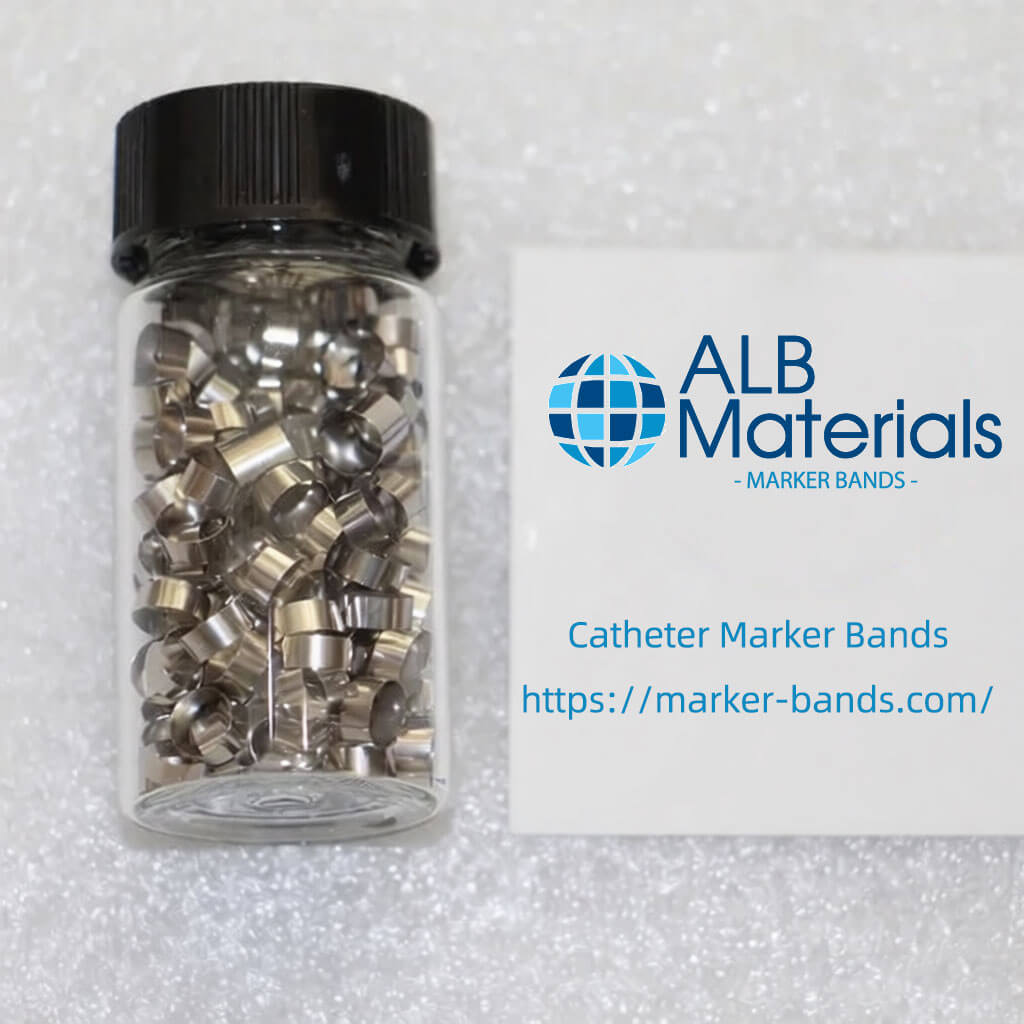
Stents. A stent delivery system needs the two bands positioned against the stent crimp, not merely somewhere on the shaft. Band width matters too: an over-long band blurs the proximal stent edge and makes accurate stent deployment harder to confirm on the final image.
Guidewires. A band near the tip tells the operator when the wire has reached the target vessel and how much of it is still outside the patient. On hydrophilic and torqueable wires it also has to survive repeated bending without cracking or sliding along the core, and that is the mode that shows up first in guidewire tracking and steering bench testing.
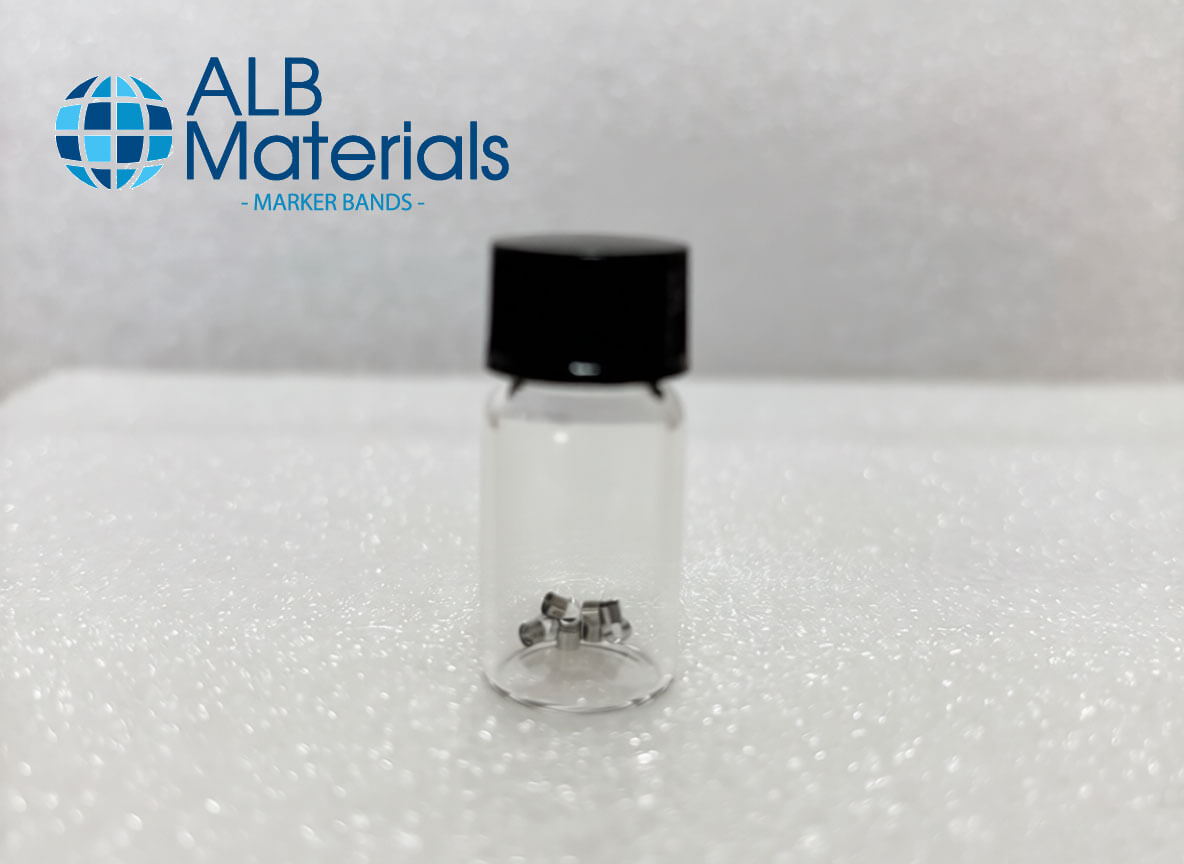
How each of these three devices uses the band — where it sits on the shaft, and what it has to survive — is covered in our note on marker bands for guiding catheters and guidewires.
Marker band materials compared
Six metals cover almost every band on the market. The choice is usually made on radiopacity first, then on how the part has to be assembled and what the implant duration will be.
| Material | Where it wins | What to weigh |
|---|---|---|
| Pt/Ir 90-10 | Highest useful radiopacity, good strength, predictable crimping and welding | Highest material cost per part |
| Platinum | Maximum contrast per unit volume, very soft, easy to form | Deforms under crimp load, so thin walls are risky |
| Gold | Clear visibility, good biocompatibility, easy to braze | Soft, lower strength, price tracks the spot market |
| Tantalum | Dense, high contrast, cost-effective in larger rings | Lower contrast than Pt/Ir at equal wall thickness |
| Niobium | Light, biocompatible, excellent corrosion resistance | Needs a thicker wall to reach the same visibility |
| Titanium | Strong, light, non-ferromagnetic | Low radiopacity, best for short bands and MRI-conditional designs |
Two more materials appear in the industry but rarely in a stock catalogue. Tungsten sits between tantalum and platinum on density and costs less than either, so it shows up in high-stress and disposable devices. Tungsten-loaded nylon is extruded rather than drawn, used where the marker has to flex with a soft shaft; it is thicker than metal for the same visibility, but there is no burr to control and no crimp to set. ALB Materials Inc stocks the six metals above and supplies custom sizes on request.
Why Pt/Ir 90-10 became the default
Density is about 21.5 g/cm³, higher than any practical alternative except pure platinum, which is too soft to hold a thin wall once the delivery system is crimped. Ten percent iridium raises hardness enough that the band keeps its shape through tracking and rotation. Both metals are inert in the body, and platinum-iridium has sat in pacemaker leads and embolization coils for decades, so the biocompatibility file is deep.
Corrosion is the quieter reason. Saline, blood and cleaning agents attack a poor alloy at the grain boundaries. A correctly drawn Pt/Ir tube resists pitting and keeps its surface intact through sterilisation.
Manufacturing matters as much as metallurgy. Band stock is drawn to size, cut, deburred, cleaned and inspected. ALB Materials Inc supplies Pt/Ir 90-10 bands to ASTM B684 with OD, ID and wall tolerances near ±0.01 mm, and keeps Pt/Ir 10 inventory on the shelf so a development build The specification route for that grade — ID, OD, wall and width tolerances, the standard sizes for each catheter system, and the RFQ checklist — is set out in a guide to Pt90Ir10 marker bands.
What has changed in the last decade
Bands got smaller, and inspection became the bottleneck. A 0.25 mm length with a 0.02 mm wall cannot be checked by eye at a bench; suppliers now rely on magnified and automated inspection, and the measurement method belongs in the purchase specification.
Bands also became drawing-driven. Engineers no longer pick the nearest size from a chart. They send a print with a critical OD and ID and let the supplier cut to it, which is faster than designing around a catalogue.
Polymer alternatives took a share of the soft-device market. Radiopaque compound extruded onto a shaft is flexible and cheap to integrate, though it never matches metal for contrast at the same profile.
Specifying a band: what a supplier needs
A request that comes back quoted within a day usually contains the material and grade, the ID, OD and wall with the critical dimensions marked, the length and its tolerance, the edge condition, the quantity, and the documentation you need with the shipment.
One detail causes most of the back and forth. A drawing can fully define only two of the three diameters, so engineers mark two as critical and one as reference, typically OD and ID critical with wall thickness as reference. Mark all three critical and the tolerance stack will not close, and the quote returns with questions instead of a price.
Marker bands from ALB Materials Inc
ALB Materials Inc has supplied radiopaque marker bands and capillary tubes for more than a decade, under ISO 13485, to over a thousand medical device customers. Stock covers Pt/Ir 90-10, platinum, gold, tantalum, niobium and titanium: OD from 0.25 mm to 12 mm, wall from 0.015 mm to 0.5 mm, cut lengths down to 0.25 mm. Catalogue sizes start at 200 pieces, and Pt/Ir 10 inventory is held for short lead times.
If the alloy is still open, the full marker band range lists sizes by material. If the geometry is already fixed, send the drawing through the inquiry form and the reply comes back with tolerance and lead time.
FAQ
What is the difference between a marker band and a ring electrode?
Often nothing physical. A ring electrode is a marker band that also carries current for pacing, sensing or ablation, so the alloy and the contact surface have to satisfy electrical requirements as well as imaging ones.
Which marker band material is the most radiopaque?
Platinum, followed closely by Pt/Ir 90-10. Tantalum and gold sit a little lower, and titanium is the least radiopaque of the six. Titanium gets specified for strength, weight and magnetic behaviour, not for contrast.
How small can a marker band be?
Bands are supplied down to 0.25 mm in length, with outside diameters from 0.25 mm and walls from 0.015 mm. Below that, handling and inspection become the limit rather than machining.
Are marker bands MRI safe?
Pt/Ir, platinum, tantalum, niobium and titanium are non-ferromagnetic, so they do not experience displacement force in the scanner. Heating and artefact depend on the whole device, and that evaluation belongs to the device manufacturer under ISO/TS 10974.
What is the minimum order quantity?
200 pieces on catalogue sizes. Custom diameters and lengths are quoted individually.
A marker band is the cheapest component on most delivery systems and the one the operator trusts most. Getting the alloy, the wall and the edge right is worth the extra conversation at the design stage.