What are Marker Bands?
A Comprehensive Guide—from First Glance to Field-Ready Expertise
Introduction
If you have ever stared at an X-ray, watched a surgeon thread a catheter on live-imaging, or traced a fiber-optic cable underground, you have already met “marker bands”—you just may not have known their name. These millimeter-scale metal rings are the invisible landmarks of modern medicine, telecommunications, and aerospace.
1. What exactly am I looking at?
1.1 The 30-second picture
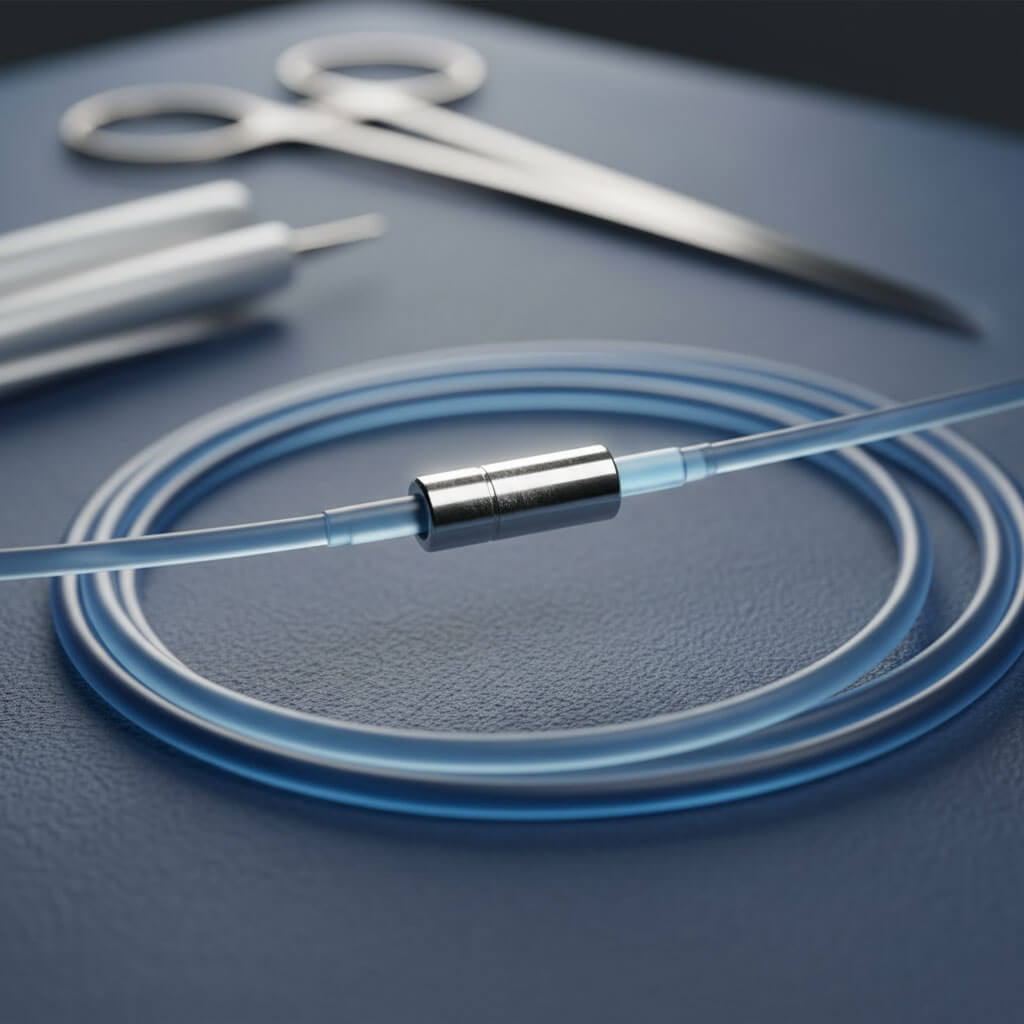
Imagine slipping a tiny wedding ring onto a drinking straw. That ring now tells you exactly where the tip of the straw is, even if the rest is underwater. A marker band does the same for catheters, guidewires, endoscopes, or fiber-optic cables. It is a short, dense metal collar—usually gold, platinum–iridium, or tungsten—crimped, swaged, or over-molded onto a flexible shaft.
1.2 Why metal and not plastic?
Dense metals block X-rays, ultrasound, or radar far better than plastic. Under imaging, the band shows up as a bright white line, giving doctors or technicians an “You are here” signal.
1.3 Everyday analogy
Think of marker bands as the reflective lane studs on a night-time highway. Without them, drivers (or doctors) would drift off course; with them, every turn is anticipated.
2. How do they work and where do they fail?
2.1 Imaging physics in one paragraph
Attenuation coefficient (µ) ∝ ρZ³/E³. In plain words: the heavier the atom (high atomic number Z) and the denser the material (ρ), the more radiation it stops. Platinum (Z = 78, ρ = 21.4 g/cm³) therefore casts a crisp radio-opaque shadow at only 25–50 µm wall thickness—thin enough to keep the catheter flexible.
2.2 Typical specifications
- Wall thickness: 0.025–0.125 mm
- Length: 0.3–3 mm (shorter for neurovascular, longer for peripheral)
- Tolerance: ±0.013 mm on diameter, ±0.025 mm on length (ISO 25539 family)
- Surface finish: Ra ≤ 0.4 µm to reduce thrombogenicity
2.3 Attachment methods compared
- Swaging (radial compression) – highest joint strength, but work-hardens the band.
- Crimping – low tooling cost, risk of ovality.
- Laser welding – hermetic, good for high-pressure balloons, but adds heat-affected zone.
- Over-molding with Pebax or HDPE – smooth outer profile, yet relies on adhesive or encapsulation; can debond after ethylene-oxide (EtO) cycles.
2.4 Failure modes seen in the clinic
- “Missing band” – band slips off distal tip during tight bend; root cause: undersized swage force or lubricious PTFE liner shrink-back.
- “Telescope sign” – band migrates proximally, exposing sharp edge; linked to cyclic fatigue in 0.014″ coronary guidewires.
- Image artifact – platinum band produces blooming on CT; misleads stent landing zone by 0.5 mm.
3. Design optimization, emerging materials, and regulatory frontier
3.1 Radiopacity vs. artifact – the quantified trade-off
Use the Figure-of-Merit (FOM) introduced by Honda et al. (IEEE TMI, 2022):
FOM = (Contrast-to-noise ratio) / (Blooming pixel width).
Sputtered Ta–Re coatings (2 µm) reach FOM = 2.4, beating Pt–Ir (20 µm) at 1.9 while preserving flexibility. However, cost per unit increases 8×.
3.2 Marker band as antenna: RF safety in MRI
A 3 mm × 0.9 mm Pt–Ir ring on a 6F catheter behaves like a resonant dipole at 128 MHz (3 T). Simulations (CST Studio) show 18 °C local heating in a 1.5 W/kg SAR phantom. Fixes:
- Laser-cut longitudinal slots to break eddy-current path.
- Replace Pt with high-resistivity Ta–Pt multilayer (ρ ≈ 200 µΩ·cm), cutting heating to < 2 °C under identical conditions.
3.3 Biodegradable marker bands
Magnesium–rare-earth alloys (Mg–5Nd–2Zn) with 35 µm Au cladding provide 4-week radio-opacity, then dissolve to < 10% volume loss per ASTM F3268. First-in-man data (Zhang et al., JACC CV Interv., 2024) show zero late embolization out to 12 months.
3.4 Additive manufacturing – platinum micro-cages
Using two-photon polymerization followed by electroforming, wall thickness down to 5 µm is achievable, reducing stiffness contribution by 60% while maintaining 98% radiographic visibility. Regulatory pathway: FDA 510(k) predicate for “catheter with radiopaque tip” requires bench comparison to predicate; micro-cage geometry is considered a “significant change” triggering new biocompatibility matrix (ISO 10993-1).
3.5 Sustainability and recycling
Platinum losses during laser cutting reach 35%. Closed-loop Ar-atmosphere collection + acid leaching recovers 92% Pt; life-cycle assessment (Sphera, 2023) shows 0.8 kg CO₂-eq saved per 1 g Pt recovered—relevant when hospitals move to Scope-3 emission reporting.
Take-home ladder
- Beginner: Marker bands = tiny metal rings that show up on X-ray so the doctor knows “where the tip is”.
- Intermediate: They are precision-engineered platinum or tungsten collars whose attenuation, geometry, and attachment method dictate both clinical safety and device performance.
- Expert: Next-gen devices will use ultra-thin coatings, biodegradable alloys, and RF-tuned geometries to balance visibility, MRI safety, and environmental cost—each change demanding new metrology, simulation, and regulatory strategy.
Summary
From the first glance on a fluoroscopy screen to the latest nano-sputtered tantalum alloy, marker bands illustrate how a component weighing micrograms can decide the outcome of a million-dollar procedure. Whether you are a student picturing a “tiny wedding ring”, an engineer optimizing swage force, or a regulator weighing MRI heating against biodegradability, the principles stay the same: visibility, fixturing, biocompatibility, and manufacturability. The next time you see that bright white stripe glide across a monitor, you will know exactly how it got there—and where the technology is heading next.
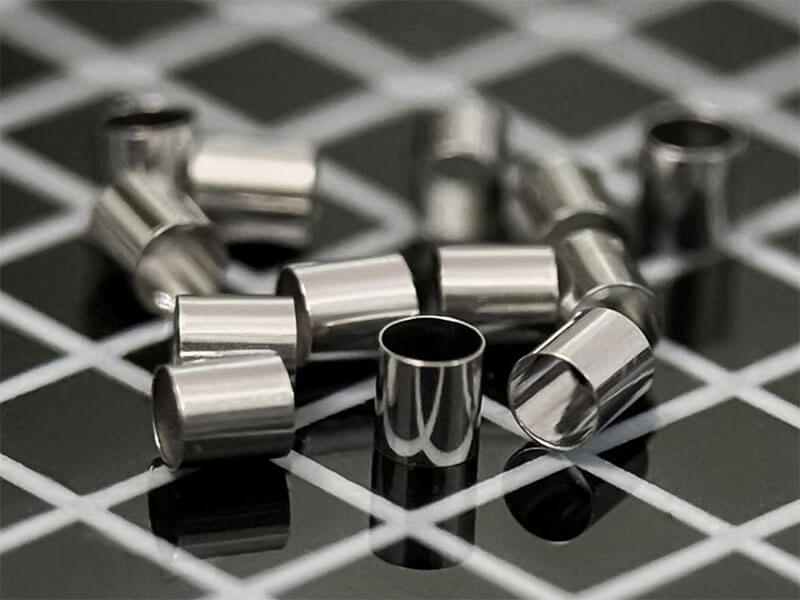
To give you a better sense of some of these, here’s an image of a medical marker band: