
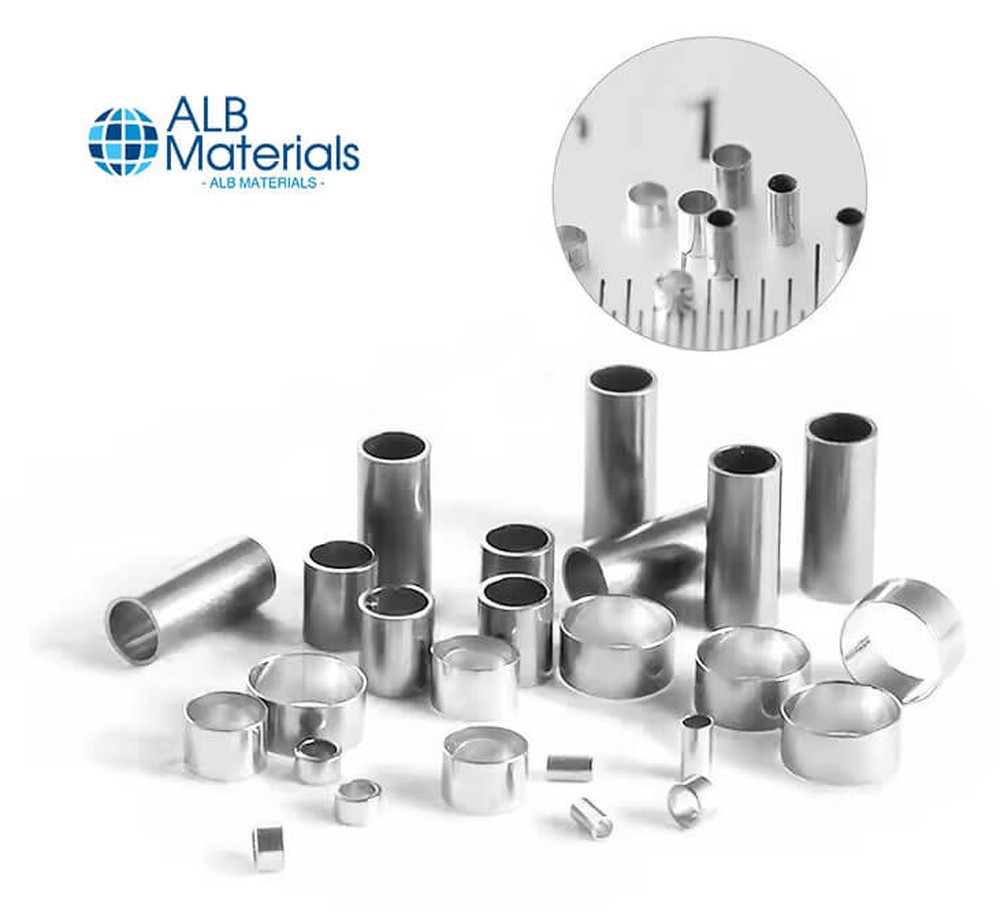

A marker band is a short ring of radiopaque metal swaged, bonded or crimped onto a catheter, guidewire, stent delivery system or balloon. Under fluoroscopy it reads as a bright ring while the tissue around it stays grey, which is how an operator knows where the working end of a device actually sits.
ALB Materials Inc supplies marker bands in platinum-iridium 90/10, platinum, gold, tantalum, niobium and titanium, cut to length from stock tube or from your drawing. Bands are disposable parts, yet they get handled like instruments during assembly: crimped, glued, sterilised, then tracked through vessels that were never designed for straight lines.
One ring, two jobs
The commonest use is a radiopaque marker for the distal working area, so the operator can see where a balloon, stent or catheter tip sits before any contrast goes in. Wire the same ring to a generator and it becomes a ring electrode for pacing, sensing or ablation. Cardiac rhythm management leads, stent delivery systems and angioplasty balloons all use it in that form.
The geometry does not change between the two. The alloy specification does. An electrode has to pass current without corroding, so surface finish and grain structure matter more than they do on a purely visual marker.
Which alloy to cut
Platinum-iridium 90/10 is the default, and not because it is the most expensive option. Density of roughly 21.5 g/cm³ blocks X-rays at a wall thickness where other alloys start to look faint, and ten percent iridium hardens the metal enough to hold a 0.02 mm wall through crimping and tracking.
Platinum gives slightly higher contrast per unit volume and is noticeably softer. That softness is the trade: a thin platinum band can deform under crimp load, so it usually appears where the band is bonded rather than swaged, or where the wall is thick enough to carry the load. Gold sits close to platinum on visibility, bonds easily when the assembly calls for brazing, and carries a price that moves with the spot market.
Tantalum is the value answer on larger rings. At 16.65 g/cm³ it still produces strong contrast, and the lower cost per part matters when the band is 3 mm across and the wall is not the binding constraint. Niobium and titanium cover the rest: niobium for weight and corrosion resistance, titanium for strength and non-ferromagnetic behaviour. Both need a thicker wall to reach the same visibility, and titanium is chosen for its magnetic properties rather than its contrast.
The full trade-off, including relative wall thickness for equal contrast and where each alloy usually lands, is in marker band materials compared.
Sizes and tolerances
| Parameter | Range |
|---|---|
| Outside diameter | 0.25 mm to 12 mm |
| Wall thickness | 0.015 mm to 0.5 mm |
| Length | cut to order, down to 0.25 mm |
| Tolerance | OD, ID and wall ±0.01 mm; length ±0.1 mm |
| Edge condition | deburred, burr-free |
| Standard | ASTM B684 for Pt/Ir 90-10 |
| Quality system | ISO 13485 |
Tolerances that tight leave no room for a worn mandrel or a dull blade, which is why the cut, not the alloy, is usually what fails a first article inspection.
Cutting, finishing, inspection
Band stock arrives as drawn tube in the specified alloy and wall. It is cut to length, deburred, cleaned and inspected, with the surface treatment matched to the next operation: a band that will be laser welded needs a different finish from one that will be bonded into a polymer shaft.
The edge is the part engineers ask about first. A burr of a few microns will not show on a drawing, but it will drag on an introducer seal or scratch a vessel wall, and it is invisible at bench magnification. Every lot is checked at the cut edge rather than by sample from the middle of the run.
How an order runs
Send the drawing with the alloy, the ID, the OD, the wall, the length and the quantity. Mark the two dimensions that are critical and leave the third as reference, because a print that calls all three critical cannot be manufactured to a closed tolerance stack.
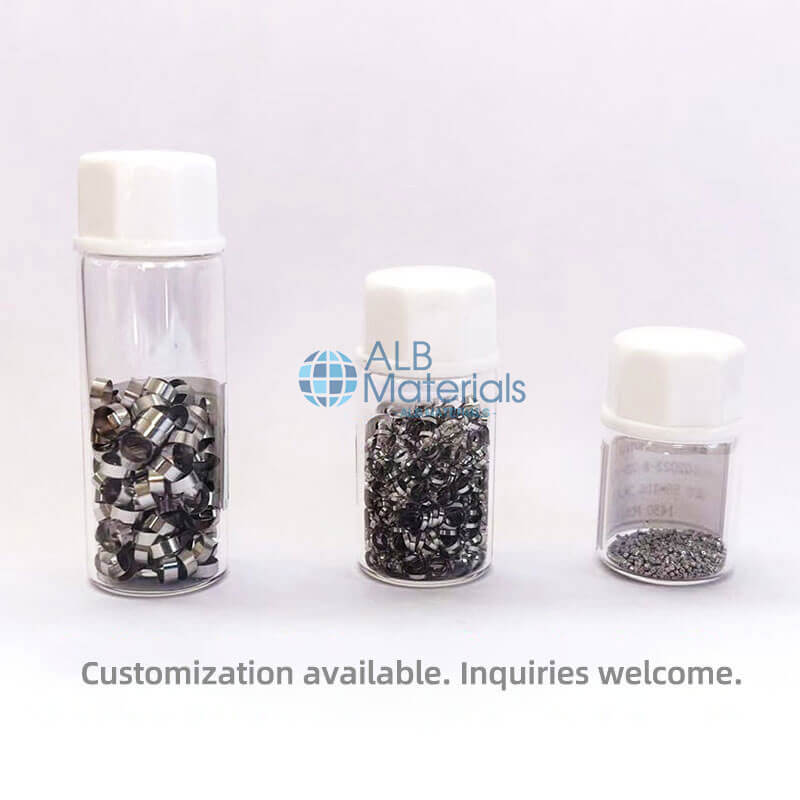
Catalogue sizes start at 200 pieces. Custom diameters and lengths are quoted individually, usually within one business day, and Pt/Ir 10 inventory is held on the shelf so a development build does not wait on a mill run. If the geometry is still open, the marker band range lists what is stocked by material; platinum iridium, tantalum and gold each have their own page.
The same alloys are also supplied as capillary tube for shaft and needle work, through ALB Materials Inc.
Packing and documentation
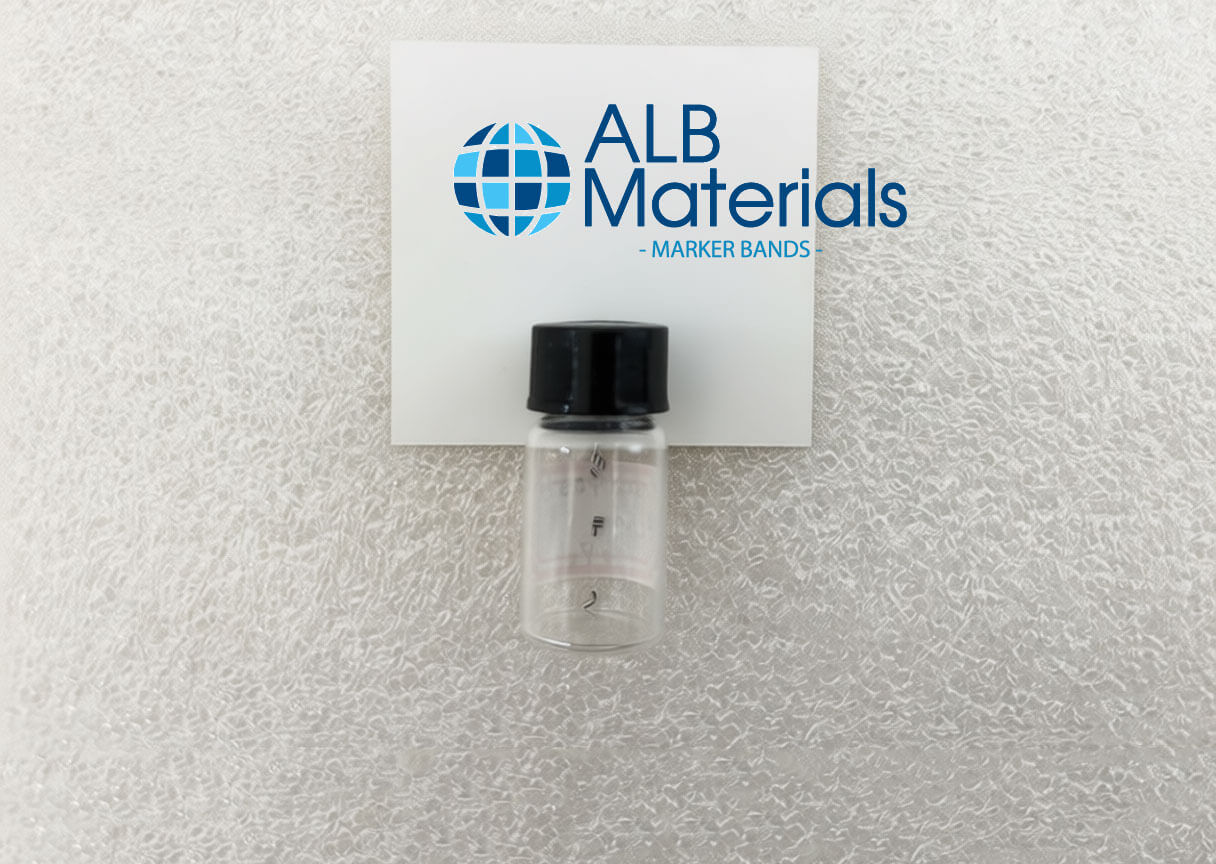
Bands ship in small bottles, packed into plastic boxes and cartons. Long capillary goes into rigid PVC tube so it cannot bend in transit. Material certification and ISO 13485 documentation travel with the shipment, and larger rings can be packed individually if your line needs to issue them one at a time.
FAQ
Can marker bands be cut to 0.25 mm?
Yes. Bands are supplied down to 0.25 mm in length, with outside diameters from 0.25 mm and walls from 0.015 mm. Below that, handling and inspection become the limit rather than the cutting itself.
Do you supply tantalum marker bands as well as platinum-iridium?
Yes, along with platinum, gold, niobium and titanium. Tantalum is the usual choice where contrast is acceptable and cost per part drives the decision.
What is the minimum order?
200 pieces on catalogue sizes. Custom sizes are quoted per drawing.
Send the drawing through the inquiry form and the reply comes back with tolerance, price and lead time.