
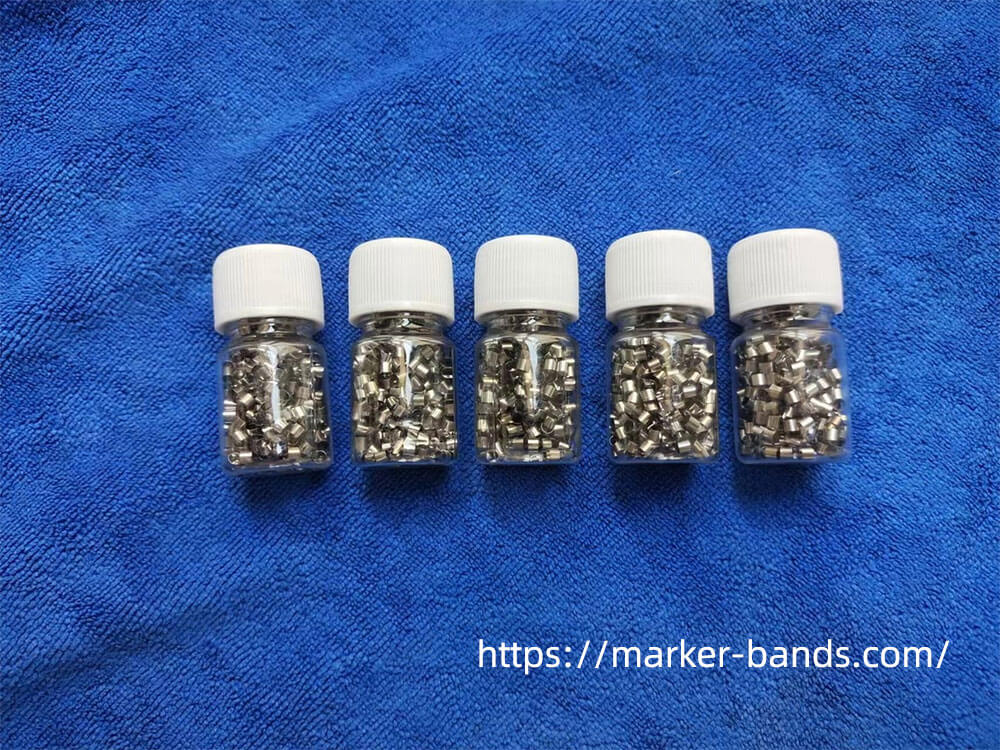

The band is 0.9 mm OD with a 0.03 mm wall, the drawing says Pt/Ir 90-10, and the buyer wants to know whether tantalum would save money. It usually would. It would also cost about 30 percent more wall thickness to hold the same contrast, which on a 0.9 mm band is most of the lumen.
That trade is the whole decision, and it is easy to miss because the two alloys look interchangeable on a purchase order.
What actually changes when you swap the alloy
Radiopacity is not a binary property. At the energies used in fluoroscopy, attenuation tracks density closely enough that density alone gets you most of the way: the same wall of a denser metal blocks more photons, and a lighter metal needs a thicker wall to reach the same darkness on screen.
Measured against Pt/Ir 90-10 at 21.5 g/cm³, the relative wall thickness needed for equal contrast runs roughly 1.0 for platinum, 1.1 for gold, 1.3 for tantalum, 2.5 for niobium and 4.8 for titanium. Edge effects and the kV spectrum shift those numbers by a few percent, but not enough to change the conclusion: on small bands, a lighter alloy is not a cheaper version of Pt/Ir, it is a different design.
| Alloy | Density (g/cm³) | Relative wall for equal contrast | Crimp behaviour | Where it usually lands |
|---|---|---|---|---|
| Pt/Ir 90-10 | 21.5 | 1.0 | Holds shape, predictable | Microcatheters, stent markers, balloons |
| Platinum | 21.5 | 1.0 | Soft, deforms under load | Bonded bands, thick walls |
| Gold | 19.3 | 1.1 | Soft, easy to braze | Assemblies that need soldering |
| Tantalum | 16.65 | 1.3 | Work-hardens, needs care | Larger rings, cost-driven programs |
| Niobium | 8.6 | 2.5 | Ductile, light | Short bands, weight-sensitive tips |
| Titanium | 4.5 | 4.8 | Strong, non-ferromagnetic | MRI-conditional designs |
For the metallurgy behind those numbers — how each alloy is drawn, why 90/10 rather than 95/5, and what grain structure does to a 0.02 mm wall — our longer treatment of platinum, gold and tantalum goes through it material by material.
Tantalum: where it pays
Tantalum is the standard answer when the band is large. A 3 mm ring with a 0.1 mm wall has room to spare, so the 30 percent more wall that tantalum needs for equal contrast costs nothing that the drawing cares about, and the metal price is a fraction of platinum’s per kilogram. Work-hardening is the catch: tantalum stiffens quickly as it is drawn, so very thin walls take more annealing passes than Pt/Ir and the practical minimum wall is higher.
Two situations where tantalum is the wrong call. A band narrower than about 1 mm, because the extra wall eats the lumen the device was designed around. And any program where the band doubles as an electrode, because the surface behaviour under current is not what tantalum was chosen for.
Gold: where it earns its price
Gold shows up where the assembly needs joining rather than crimping. It brazes and solders easily, it is biocompatible, and it stays bright on imaging. The cost is the obvious objection, and it is worth checking whether the joint could be redesigned instead: a Pt/Ir band bonded with adhesive is often cheaper than a gold band that exists only to be soldered.
Pt/Ir: when there is no substitute
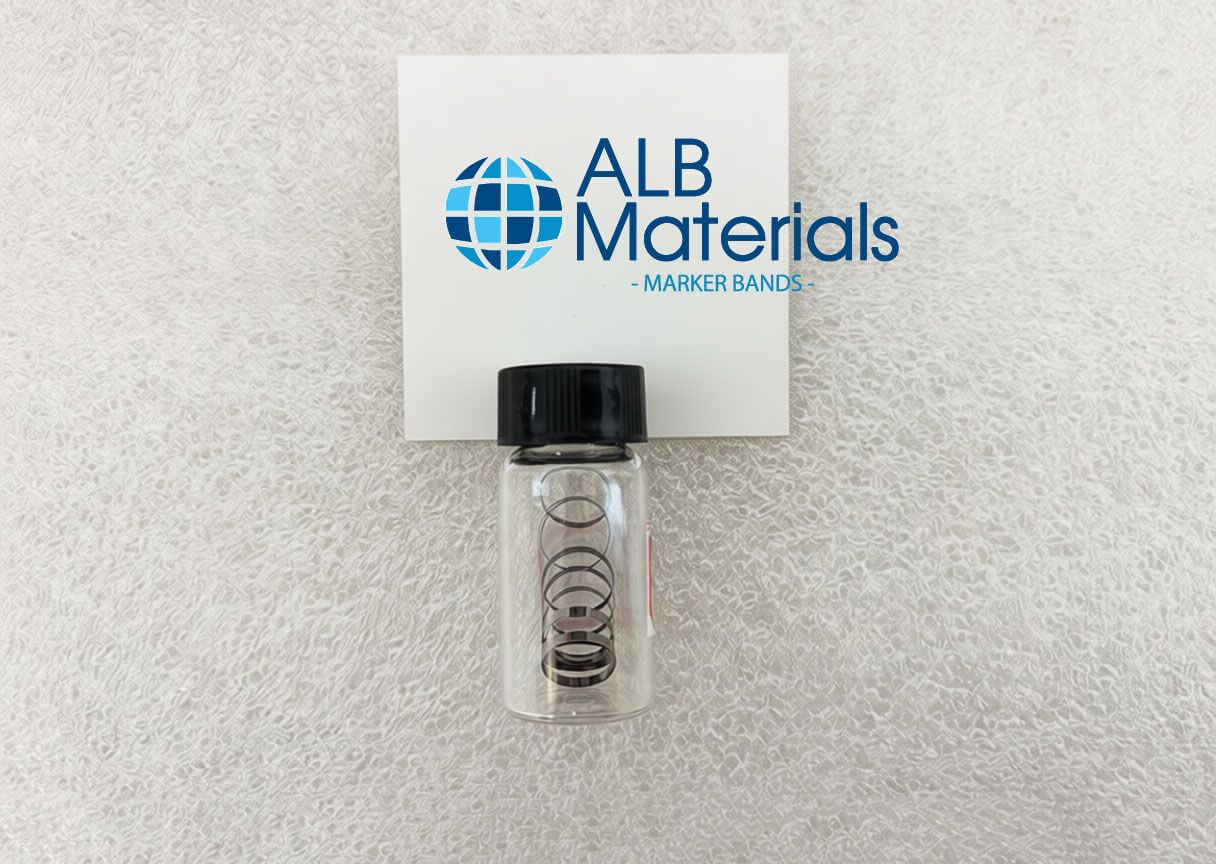
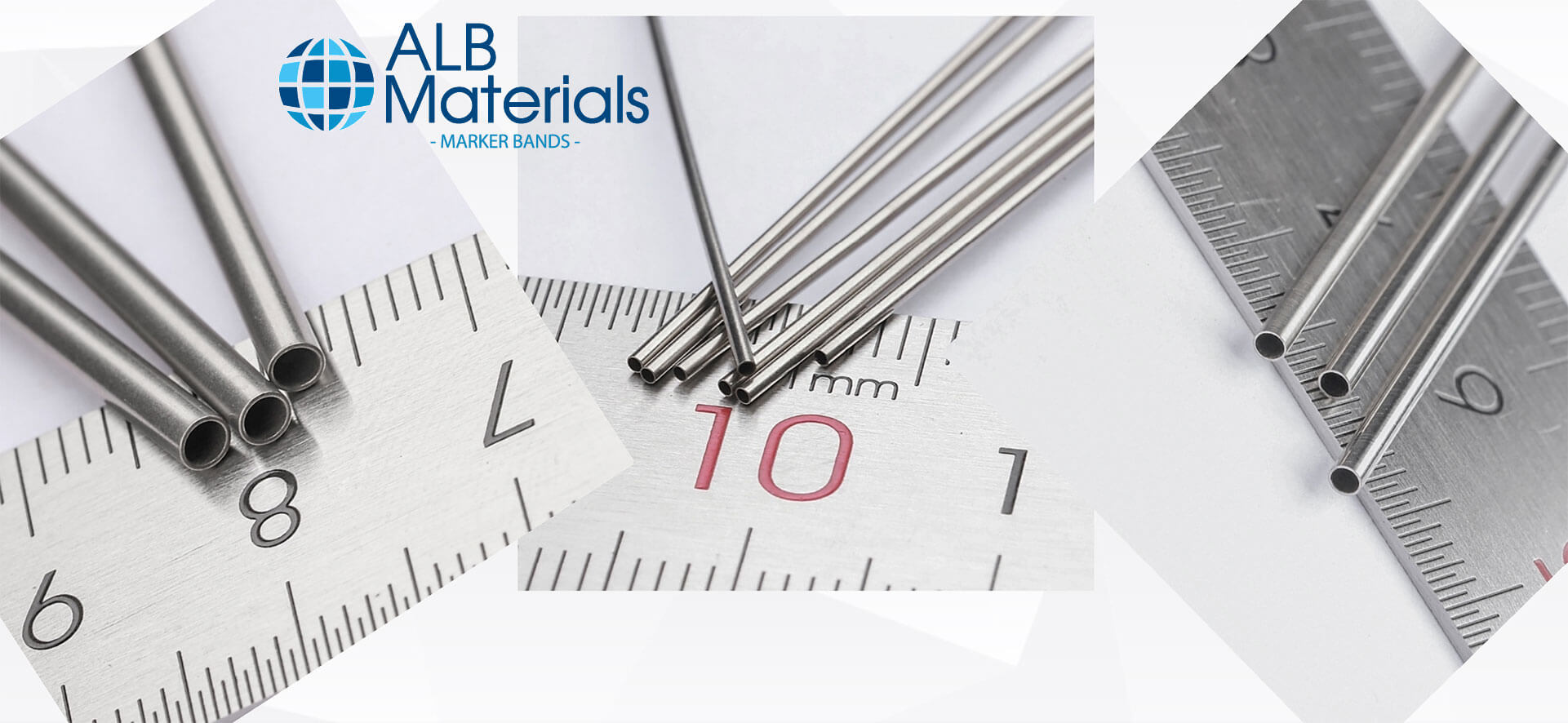
Platinum-iridium 90-10 wins wherever the wall is thin and the lumen matters. Ten percent iridium raises hardness enough for a 0.02 mm wall to survive crimping and tracking, and the alloy has decades of implant history behind it. It is also the only one of the six with both a stocked size range and a published standard behind it: ALB Materials Inc supplies Pt/Ir 90-10 bands to ASTM B684 with OD, ID and wall tolerances near ±0.01 mm.
The cost argument against Pt/Ir is real but usually smaller than it looks. On a single small marker the metal content is a minor line in the part cost, while a failed first article inspection runs into weeks. A cheaper alloy that misses tolerance twice has already cost more than the platinum.
When the answer is not a metal
Very small markers on soft, kink-prone shafts are increasingly radiopaque polymer rather than metal tube. Tungsten-loaded nylon extrudes onto the shaft, needs no crimp, and cannot burr. The trade is profile: a polymer band is noticeably thicker than a metal one for the same visibility, and it will not hold a tight tolerance on the ID.
Useful when the shaft is the constraint. Useless when the lumen is.
What goes wrong in an RFQ
Most avoidable failures start on the drawing rather than in the shop. A lighter alloy gets specified at the original wall thickness with no adjustment for density, and the band arrives about 30 percent fainter than the one it replaced.
Or all three diameters get marked critical, which no tube drawing can close, so the quote comes back as a question instead of a price.
The cheapest one to avoid is the alloy name. Specify grade and standard rather than a trade name, because two suppliers’ “Pt/Ir” are not always the same 90/10.
If the drawing is still open, the selection criteria — radiopacity first, then mechanical load, then biocompatibility, then cost — are set out in this short primer on material selection.
FAQ
Is tantalum as radiopaque as platinum-iridium?
No, and the gap is predictable. At 16.65 g/cm³ against 21.5 g/cm³, tantalum needs roughly 30 percent more wall thickness to match Pt/Ir on screen. On rings with wall to spare that is irrelevant; on sub-millimetre bands it decides the design.
Why not use pure platinum instead of Pt/Ir?
Contrast is essentially the same, since iridium and platinum are close in density. The difference is mechanical: pure platinum is soft enough to deform under crimp load, so a thin platinum band can lose its grip on the shaft. Pt/Ir holds its shape.
Which alloy is cheapest per part?
Titanium and niobium sit at the bottom of the metal price ladder, tantalum in the middle, platinum and gold at the top. Per finished part the ranking often reverses, because yield and inspection cost dominate once the walls get thin.
The marker band range lists stocked sizes by alloy, and each material has its own page: platinum iridium, platinum, gold, tantalum, niobium and titanium. If the alloy is still open, send the application through the inquiry form and the answer comes back with a recommended material and wall.